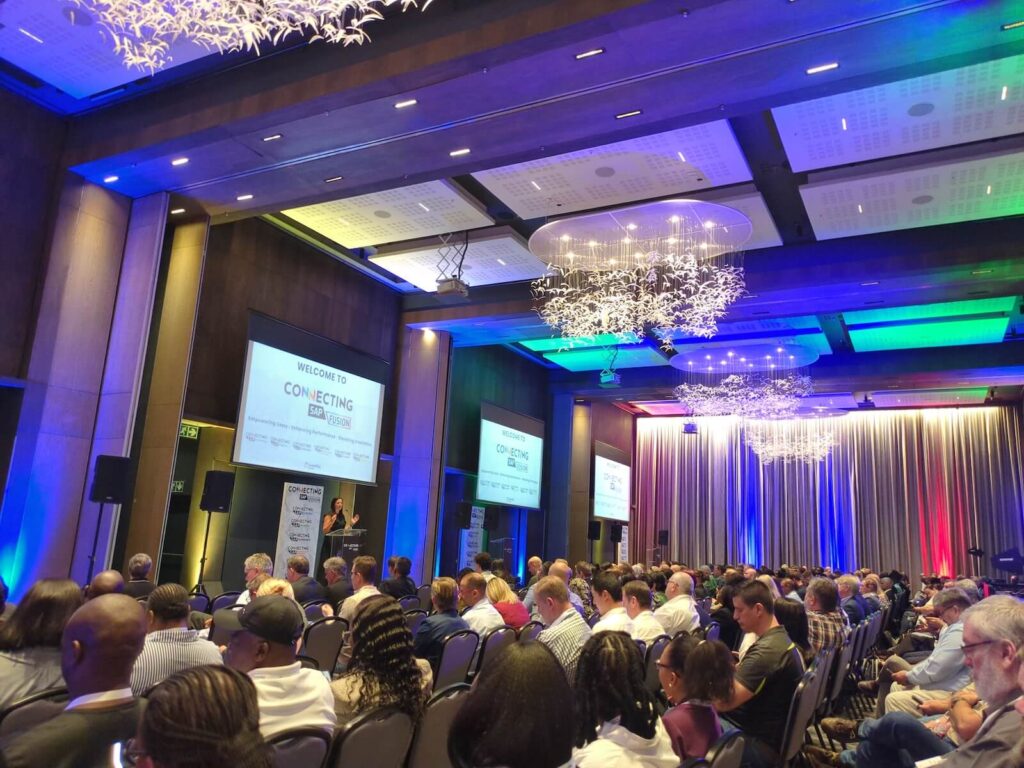
Connecting SAP Fusion 2026 took place at the Marriott Hotel in Sandton, Johannesburg (15–16 March), and Robert Peter had the chance to attend in person. As always, these events are a great pulse check for the SAP ecosystem—especially in South Africa. The agenda was packed: Enterprise Asset Management, Finance, HR & Payroll, Procurement, Supply Chain, Digital Manufacturing, and of course, Technology. But going in, Robert had one key question in mind: which of these topics will truly shape the SAP landscape in South Africa?
AI – Not Just a Buzzword Anymore
If I had to summarise the conference in one word, it would be: AI.
It came up everywhere. Not just in keynotes like the one from Sindhu Gangadharan (SAP Labs India), but across almost every track.
One session that really stuck with me was “Finance Automation with Agentic AI” by Marco Bronze and Charlie Kwint. What I found interesting was how confidently AI and Agentic AI is now positioned—not as support, but as execution.
We’re talking about AI:
- generating financial figures
- writing reports
- distributing them automatically
That’s a massive shift. Finance teams won’t disappear—but their role is clearly evolving from doing the work to controlling and validating it.
Where It Gets Really Interesting: Development
For me personally, the most exciting part was around software development.
Dylan Fasser from SAP spoke about SAP Joule and how development could look in the future—combining SAP Build, low-code, pro-code, and generative AI.
The direction is clear:
Developers will spend less time writing code—and more time guiding systems.
That said, I couldn’t help but ask: What about legacy systems like SAP CRM WebUI?
There wasn’t a clear answer. And honestly, I think that tells us something—Joule is built for modern architectures. For many customers, especially here in South Africa, the real challenge will be bridging that gap.
A Session That Really Delivered
If I had to pick one speaker who stood out for me, it would be Geert-Jan Klaps (SAP Innovation Architect & SAP Mentor, TheValueChain NV).
Across two sessions—
- “SAP BTP as the Foundation for Partner SaaS Solutions”
- “Taking Development to the Next Level With AI-Infused Development Strategies”
—he delivered a compelling and practical perspective.
What I appreciated most was how practical his talks were.
He showed clearly that:
- You don’t need to be a huge SAP partner to build SaaS solutions
- SAP BTP can be a real foundation for product businesses
- And AI is already usable today—not in theory, but in delivery
The part that really resonated with me was his take on AI-assisted development:
- using tools like Cursor and Cline
- connecting them via MCP servers
- ensuring generated code actually compiles, fits, and ships
That’s the difference: AI that works in real projects—not just demos.
The Real Value: Conversations
As valuable as the sessions were, the biggest insights came from conversations.
I spoke with customers and partners from industries like mining and water utilities, and what stood out was:
- a strong interest in AI—but also a lot of uncertainty
- real demand for practical, scalable solutions
- ongoing challenges with legacy systems
I also had the chance to reconnect and exchange ideas with people like Derek Wood and Warren Eiserman—both deeply involved in SAP and AI innovation.
These conversations reinforced a key takeaway:
The SAP ecosystem in South Africa is not just consuming innovation—it is actively shaping it. These discussions reminded me why I enjoy these events so much:
It’s not just about technology—it’s about people building things together.
My Takeaway
Walking away from the conference, one thing is clear to me:
AI is not coming. It’s already here—and it’s changing how we build SAP solutions.
But the real question is not whether AI matters. It’s how we use it responsibly and effectively in real customer scenarios.
For me, especially in the context of Redcup Code, that means:
- focusing on practical extensions
- leveraging BTP where it makes sense
- and using AI to accelerate—not complicate—delivery
Because at the end of the day, it’s not about the tools.
It’s about what we build with them.
And that’s where things are getting really interesting. 🚀