
We live in a fast-paced world, with enormous amounts of data generated every day. This isn’t only true in our private lives—it is even more relevant in business. Increasingly, AI is being used to help us make sense of all this information.
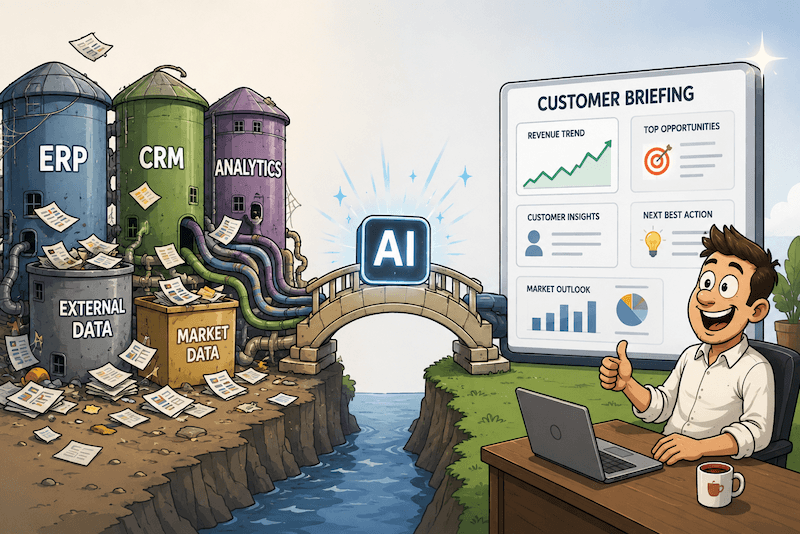
Over the years, companies have built up numerous data silos containing valuable business information. CRM knows about customers and opportunities. ERP knows about orders and revenue. Analytics platforms know about KPIs and trends. And then there are external and proprietary data sources that add another layer of intelligence.
In one of our recent projects, we discussed a seemingly simple question: How can we bring all this information together and make it useful for better and faster decision-making?
The Hidden Gold in Enterprise Data
In our customer scenario, information was distributed across several SAP and non-SAP systems.
Business data came from ERP, CRM and analytics solutions. This was complemented by external sources such as Creditreform and, perhaps most importantly, an internally developed database containing years of proprietary market information.
That last source was particularly interesting.
It represented knowledge about market developments, customers and business relationships that had been accumulated over many years. In other words: information you cannot simply buy somewhere else.
The data was there. The challenge was making it accessible and meaningful.
From Data Silos to an AI-Driven Customer Briefing
The customer’s ambition was straightforward:
How can we bring these different data silos together? And how can we make their combined knowledge easily accessible to the sales organization?
Several potential solutions quickly emerged. One idea stood out: an AI-driven Customer Briefing.
Imagine a salesperson preparing for an important customer meeting.
Instead of opening CRM, checking ERP figures, searching analytics dashboards, consulting external databases and asking colleagues for additional information, the salesperson could ask for a consolidated briefing:
What is happening with this customer? What has changed since our last meeting? Which opportunities are currently open? How is revenue developing? What is happening in their market? And where should I focus the conversation?
Generative AI makes this type of experience increasingly realistic.
But while discussing the architecture, we realized that connecting an LLM to multiple systems was actually not the hardest part.
The real question was:
Can we create one reliable business context from data that was never designed to work together?
That changed the discussion considerably.
We identified four fundamental challenges: data quality, semantic consistency, data ownership and access, and trust in the consolidated result.
Before AI could create meaningful customer briefings, some homework had to be done.
1. Data Quality: Fix the Foundation First
The first challenge was data quality.
We had to establish minimum quality standards for each data source, identify duplicates, detect stale or incomplete information and determine which data could actually be trusted.
Most importantly, the information needed to be validated before it entered the Customer Briefing.
And this is where traditional groundwork remains fundamental.
AI can help identify anomalies or potentially problematic records, but it cannot magically turn fundamentally poor enterprise data into reliable business information. If nobody knows which customer record is correct, which revenue figure should be used or whether an opportunity is still active, adding an LLM does not solve the underlying problem.
The old principle remains surprisingly relevant:
Garbage in, garbage out.
Put unreliable information into an AI-driven briefing and you risk receiving an impressively written—but unreliable—answer.
2. Semantic Consistency: Creating One Business Language
The second challenge was more subtle.
Different systems can contain perfectly correct data while still disagreeing about what that data means. A great example of relevant questions in this field are as follows:
- What exactly is a customer?
- What does “revenue” mean?
- What qualifies as pipeline?
- How is margin calculated?
- What is the relevant sales target?
The answers may differ depending on whether you ask CRM, ERP, Analytics or Finance.
We therefore established a common business and semantic layer defining core concepts such as Customer, Revenue, Pipeline, Opportunity, Margin and Sales Target.
Each source system could then be mapped against those definitions, including explicit rules for situations where systems provide conflicting information.
This is critical because the AI should not be expected to decide spontaneously which definition of “revenue” the company intended.
First establish one business language. Then let AI reason with it.
3. Data Ownership & Access: Just Because We Can Access It Doesn’t Mean We Should
Bringing previously separated information together introduces another important question:
Who is actually allowed to see what?
The customer therefore needed to establish clear ownership for each data source and business domain.
Data owners determine who may consume information, under which circumstances and at what level of detail.
Where possible, existing SAP roles and authorizations can provide the foundation. Depending on the scenario, additional role-based access controls and even field-level restrictions may be necessary.
One principle should remain non-negotiable:
The AI must not have access to information that the requesting user is not authorized to see.
An AI platform connecting multiple enterprise systems should not accidentally become the most powerful superuser in the organization.
Security and authorization therefore need to follow the data throughout the entire process—from the source system to the generated briefing.
4. Trust: Show Me Where the Answer Came From
Finally, even a technically perfect Customer Briefing has little value if salespeople don’t trust it.
Imagine receiving the following statement:
“Customer revenue declined by 12%.”
The immediate questions are obvious.
Compared with which period? Which revenue definition was used? Which system supplied the figure? When was the information last updated?
This is why we designed the results to be traceable and explainable.
Important facts and KPIs should reference their underlying source, timestamp and, where applicable, calculation logic.
Equally important is the distinction between facts and AI interpretation.
For example:
Fact: Customer revenue decreased by 12% year-on-year.
Interpretation: The decline, combined with reduced opportunity volume, could indicate declining customer engagement.
Recommendation: Discuss the customer’s investment priorities during the upcoming meeting.
These are three very different types of information.
Making that distinction visible dramatically increases transparency—and ultimately trust.
AI Is the Last Mile, Not the Starting Point
One of the most important lessons from this scenario was that building an AI-driven Customer Briefing is not primarily an AI problem.
It is a data and business-context problem.
The integration and semantic layers need to provide clean, authorized and contextualized information. Only then should AI take over what it does particularly well: connecting the dots, summarizing large amounts of information, identifying patterns and generating recommendations.
In other words:
Don’t ask AI to make inconsistent enterprise data consistent. Give AI a reliable business context and let it turn that context into insight.
Once that foundation exists, previously isolated data silos can become something much more valuable: a consolidated view of the customer that helps sales teams understand situations faster, prepare better and ultimately make better decisions in less time.
Conclusion: AI is not the answer to everything
Faster decision-making isn’t about simply connecting more data to AI. Or simply putting tools in place, like SAP Generative AI Hub. Once data quality, semantic consistency, clear access rules, and trust are established, AI can turn scattered data silos into meaningful insights—and meaningful insights into better, faster decisions. But you need to make your homework first. In one of our next articles, we’ll cover how we crafted the solution from an architectural perspective. Stay tuned.

